
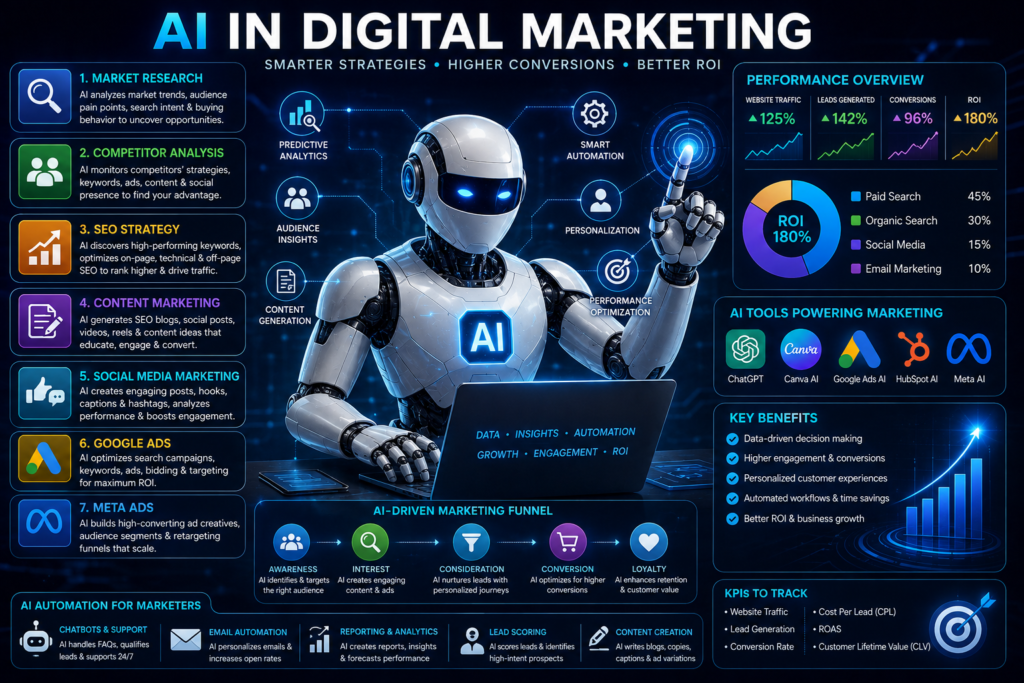
AI in Digital Marketing: Transforming the Future of Marketing
AI in Digital Marketing: How Artificial Intelligence Is Transforming Modern Marketing
Introduction
Digital marketing has changed dramatically over the past decade. Businesses that once relied primarily on newspapers, television advertisements, billboards, email campaigns, and traditional sales methods can now reach highly targeted audiences through search engines, social media, websites, mobile applications, video platforms, and digital advertising networks.
However, the digital landscape has also become increasingly complex. Consumers generate enormous amounts of data through searches, clicks, purchases, social media interactions, website visits, video views, and online conversations. Marketers are expected to analyze this information, create personalized experiences, produce content consistently, optimize advertising campaigns, respond to customers quickly, and demonstrate measurable returns on investment.
This is where Artificial Intelligence (AI) is becoming one of the most important technologies in digital marketing.
AI allows marketers to analyze large amounts of information, identify patterns, predict customer behavior, automate repetitive activities, generate content, personalize communication, optimize advertising campaigns, and improve customer experiences. Instead of replacing marketing strategy, AI can act as an intelligent assistant that helps marketers make faster and more informed decisions.
From AI-powered SEO and content creation to predictive analytics, chatbots, recommendation engines, Google Ads, Meta Ads, email automation, and customer segmentation, artificial intelligence is influencing almost every stage of the digital marketing funnel.
The future of marketing is therefore not simply about using more technology. It is about combining human creativity, strategic thinking, customer understanding, and AI-powered intelligence to create marketing that is more relevant, efficient, measurable, and scalable.
What Is AI in Digital Marketing?
AI in digital marketing refers to the use of artificial intelligence technologies to plan, execute, automate, analyze, and optimize marketing activities.
Traditional marketing often depends on marketers manually analyzing data and making decisions based on experience. AI changes this process by allowing software systems to process enormous datasets and identify patterns much faster.
AI-powered marketing systems can help answer questions such as:
-
Who is most likely to purchase a product?
-
Which keywords are generating qualified traffic?
-
What type of content attracts the target audience?
-
Which advertisement is generating the best return?
-
When should an email be sent?
-
Which customers are likely to stop purchasing?
-
What products should be recommended to a customer?
-
Which leads are most likely to convert?
-
What message should be shown to a particular audience?
-
Which marketing channels are producing the highest ROI?
AI can support marketers throughout the entire customer journey, from awareness to consideration, conversion, retention, and loyalty.
The most important advantage is not simply automation. The real value comes from using data intelligently to make better marketing decisions.
Why AI Is Important for Digital Marketing
Modern consumers expect brands to understand their needs. They want relevant recommendations, fast customer support, personalized content, convenient purchasing experiences, and useful information.
At the same time, marketers face increasing competition.
Thousands of brands may compete for the same search keywords, social media attention, advertising impressions, and customers. Creating generic marketing content is no longer enough.
AI provides several important advantages.
1. Faster Data Analysis
Businesses generate huge amounts of marketing data. AI can analyze customer behavior, website traffic, advertising performance, engagement, and conversion patterns much faster than manual analysis.
2. Personalization
AI can help marketers deliver different messages to different customer segments based on their interests, behavior, location, previous interactions, and purchasing patterns.
3. Automation
Repetitive activities such as reporting, email segmentation, lead scoring, chatbot responses, content ideation, and campaign monitoring can be partially automated.
4. Better Decision-Making
AI can identify patterns that may be difficult to recognize manually. Marketers can use these insights to improve targeting, content, campaigns, and customer experiences.
5. Improved Efficiency
AI can reduce the amount of time required for research, content development, analysis, and optimization.
6. Scalability
A small marketing team can use AI to perform tasks that previously required larger teams and significant amounts of time.
AI and Market Research
Market research is one of the foundations of successful digital marketing.
Before launching a campaign, businesses need to understand their customers, competitors, industry trends, pain points, purchasing behavior, and market opportunities.
AI can accelerate this research process.
An AI-powered research workflow can analyze:
-
Customer reviews
-
Search queries
-
Social media discussions
-
Website behavior
-
Competitor content
-
Customer surveys
-
Product feedback
-
Industry trends
-
Frequently asked questions
-
Online conversations
For example, a company selling fitness equipment could use AI to identify common customer concerns such as price, available space, product durability, ease of use, delivery, and maintenance.
These insights can then influence website copy, blog topics, advertising messages, product pages, and social media content.
AI can also help identify customer personas.
A business may discover that its audience includes:
Persona 1: The Researcher
This customer compares several products before making a decision. They respond well to comparison guides, reviews, demonstrations, and detailed product information.
Persona 2: The Price-Conscious Buyer
This customer is primarily concerned with value. Discounts, offers, bundles, and transparent pricing may be more effective.
Persona 3: The Convenience-Seeker
This customer values speed and simplicity. Easy ordering, fast support, and straightforward explanations may influence their decision.
Instead of creating one generic campaign for everyone, marketers can develop specific campaigns for each segment.
AI in Search Engine Optimization
Search Engine Optimization, or SEO, remains an important part of digital marketing because search engines connect users with information, products, and services.
AI can improve almost every stage of an SEO strategy.
AI-Powered Keyword Research
Traditional keyword research can be time-consuming. AI can help marketers identify keyword themes, related questions, search intent, and content opportunities.
For example, instead of targeting only a broad keyword such as:
“digital marketing”
AI can help expand the topic into related searches such as:
-
AI in digital marketing
-
AI digital marketing tools
-
AI marketing strategy
-
benefits of AI in marketing
-
AI SEO tools
-
AI content marketing
-
AI marketing automation
-
AI for social media marketing
-
AI advertising optimization
This creates a broader topical strategy.
Understanding Search Intent
Keywords alone are not enough.
A marketer must understand why someone is searching.
Search intent generally falls into categories such as:
-
Informational
-
Navigational
-
Commercial investigation
-
Transactional
Someone searching for “what is AI marketing” probably wants educational content.
Someone searching for “best AI marketing tools” may be comparing solutions.
Someone searching for “AI marketing software pricing” may be close to making a purchasing decision.
AI can help categorize keywords according to intent, allowing marketers to create content that matches the user’s stage in the buying journey.
Content Optimization
AI can analyze existing content and identify opportunities involving:
-
Missing topics
-
Related concepts
-
Content structure
-
Frequently asked questions
-
Internal linking opportunities
-
Readability
-
Search intent
-
Content depth
However, AI-generated content should not simply be published without human review.
Search visibility depends on usefulness, relevance, credibility, and the ability to genuinely satisfy users.
The best approach is AI-assisted content creation with human expertise and editorial quality control.
AI in Content Marketing
Content marketing is one of the areas where AI has had the biggest impact.
Marketers need to produce blogs, articles, social media posts, videos, advertisements, newsletters, product descriptions, landing pages, case studies, and other forms of content.
AI can help generate ideas and accelerate production.
For example, one central blog about AI in digital marketing can be transformed into:
-
Five LinkedIn posts
-
Ten Instagram post ideas
-
Three short-form video scripts
-
A newsletter
-
An infographic
-
A carousel
-
Several social media captions
-
Frequently asked questions
-
A downloadable guide
This process is called content repurposing.
Instead of creating every piece from scratch, marketers can build a content ecosystem around a central topic.
AI Content Workflow
A practical AI-assisted workflow could look like this:
Research → Strategy → Outline → Draft → Human Editing → SEO Optimization → Design → Distribution → Performance Analysis
AI can assist at almost every stage.
However, human involvement remains important.
AI may produce grammatically correct content that sounds generic. A human marketer adds:
-
Brand personality
-
Original opinions
-
Experience
-
Examples
-
Stories
-
Industry knowledge
-
Emotional connection
-
Strategic context
The strongest content strategy therefore combines AI efficiency with human originality.
AI for Social Media Marketing
Social media marketers must constantly create content and monitor audience behavior.
AI can help with:
-
Content ideas
-
Captions
-
Hooks
-
Hashtag research
-
Audience analysis
-
Content calendars
-
Social listening
-
Sentiment analysis
-
Video scripts
-
Creative variations
-
Performance analysis
For example, a social media strategist could ask AI to transform one product benefit into different formats.
A single idea might become:
Instagram Reel Hook:
“Still wasting hours doing this manually?”
LinkedIn Post:
“Five ways AI can reduce repetitive marketing tasks.”
Instagram Carousel:
“7 AI workflows every marketer should automate.”
Short Video:
“Here are three ways AI can improve your marketing ROI.”
The key is not to post the same content everywhere without modification.
Each platform has its own audience behavior and content style.
LinkedIn may reward professional insights and business education.
Instagram often focuses heavily on visual storytelling and short-form content.
YouTube supports long-form educational content as well as Shorts.
Facebook can work well for communities, local businesses, and broader demographic targeting.
AI can help adapt the same core message for each platform.
AI in Google Ads
Paid search advertising requires constant optimization.
Advertisers need to manage:
-
Keywords
-
Search terms
-
Bids
-
Ad copy
-
Audiences
-
Landing pages
-
Conversion tracking
-
Budget allocation
-
Campaign structure
AI-powered advertising systems can analyze campaign performance and identify patterns.
For example, AI can help marketers determine:
-
Which search terms generate conversions
-
Which audiences have stronger conversion rates
-
Which advertisements generate more engagement
-
Which landing pages perform better
-
Where budget may be wasted
-
Which campaigns deserve additional investment
AI can also assist with generating multiple advertising variations.
A campaign could test different messaging angles such as:
Benefit-focused:
“Grow Your Business with Smarter Digital Marketing”
Problem-focused:
“Struggling to Generate Quality Leads?”
ROI-focused:
“Turn Marketing Data Into Higher-Value Leads”
AI-focused:
“Use AI to Optimize Your Digital Marketing”
The important principle is to test different hypotheses rather than blindly generating hundreds of variations.
AI in Meta Advertising
Platforms such as Facebook and Instagram rely heavily on machine learning for audience delivery and advertising optimization.
Marketers can use AI to support:
-
Audience research
-
Creative development
-
Ad copy
-
Video concepts
-
Retargeting strategies
-
Campaign analysis
-
Creative testing
-
Customer segmentation
A typical Meta advertising funnel might include three stages.
Awareness
The objective is to introduce the brand.
Content could include:
-
Educational videos
-
Brand stories
-
Industry insights
-
Short-form videos
-
Problem-awareness content
Consideration
The audience already knows the brand.
Content could include:
-
Product demonstrations
-
Case studies
-
Testimonials
-
Comparison content
-
Webinars
-
Guides
Conversion
The audience is closer to making a purchase.
Content could include:
-
Special offers
-
Free consultations
-
Product trials
-
Limited-time promotions
-
Strong calls to action
AI can help analyze how audiences move between these stages and identify opportunities for optimization.
AI Chatbots and Customer Support
Customer expectations have changed.
People increasingly expect immediate answers.
AI chatbots can provide support 24 hours a day and handle common questions about:
-
Products
-
Pricing
-
Availability
-
Shipping
-
Services
-
Appointments
-
Returns
-
Business hours
-
Basic troubleshooting
A chatbot can also qualify leads.
For example:
Chatbot: What service are you interested in?
Customer: SEO.
Chatbot: What is your approximate monthly marketing budget?
Customer: ₹50,000.
Chatbot: How soon are you looking to start?
The system can then categorize the lead according to predefined criteria.
Instead of sending every inquiry directly to a salesperson, businesses can prioritize high-intent prospects.
Human representatives should remain available for complex or sensitive issues.
AI-Powered Personalization
Personalization is one of the most powerful applications of AI.
Traditional marketing often delivers the same message to everyone.
AI allows brands to create more individualized experiences.
For example, an ecommerce website could recommend products based on:
-
Previous purchases
-
Browsing behavior
-
Search history
-
Product preferences
-
Customer segment
-
Similar customer behavior
An email marketing system could also personalize:
-
Subject lines
-
Product recommendations
-
Offers
-
Content
-
Send times
-
Follow-up sequences
Personalization can make marketing feel more relevant and useful.
However, personalization must be implemented responsibly. Businesses should respect privacy, use customer data appropriately, and avoid making customers uncomfortable through excessive tracking or overly intrusive messaging.
AI in Email Marketing
Email marketing remains valuable because businesses can communicate directly with their audiences.
AI can improve email campaigns through:
Subject Line Generation
AI can generate multiple subject line variations for testing.
Audience Segmentation
Customers can be grouped according to behavior.
For example:
-
New subscribers
-
Repeat customers
-
Inactive customers
-
High-value customers
-
Cart abandoners
-
Product-interest segments
Send-Time Optimization
AI can analyze engagement patterns and help determine when different segments are most likely to open emails.
Automated Sequences
AI can assist in designing automated journeys such as:
Welcome Email → Educational Email → Product Introduction → Case Study → Offer → Follow-Up
This allows marketers to nurture leads without manually sending every message.
Predictive Analytics in Digital Marketing
Predictive analytics uses historical and behavioral data to estimate future outcomes.
For example, AI may help identify customers who are:
-
Most likely to purchase
-
Most likely to unsubscribe
-
Most likely to become repeat customers
-
More responsive to specific offers
-
More valuable over their lifetime
This allows marketers to allocate resources more intelligently.
Suppose a business has 10,000 leads.
Instead of treating every lead equally, AI-powered lead scoring could identify a smaller group of high-intent prospects.
Sales teams can then prioritize those prospects.
This can improve efficiency and reduce wasted effort.
AI for Conversion Rate Optimization
Driving traffic to a website is only part of digital marketing.
The real question is:
What percentage of visitors become customers or leads?
AI can help identify potential conversion problems.
A landing page may have:
-
Too many fields
-
Weak headlines
-
Confusing navigation
-
Poor mobile design
-
Slow loading
-
Weak trust signals
-
Unclear pricing
-
A weak call to action
AI-assisted analysis can help marketers identify patterns in user behavior.
For example, if many visitors reach a pricing page but few continue to the contact form, marketers can investigate whether the pricing explanation, offer, trust signals, or CTA needs improvement.
Potential improvements include:
-
Stronger headlines
-
Clearer CTAs
-
Shorter forms
-
Customer testimonials
-
Case studies
-
Product demonstrations
-
FAQ sections
-
Guarantees where appropriate
-
Better mobile experiences
AI can help generate and prioritize experiments, but actual performance should be validated through real user data and controlled testing.
AI Marketing Automation
One of the biggest benefits of AI is the ability to automate repetitive marketing tasks.
Examples include:
Content Automation
Generate content ideas, outlines, captions, and variations.
Reporting Automation
Create recurring summaries of campaign performance.
Lead Qualification
Score leads based on predefined criteria.
Customer Support
Answer frequently asked questions.
Email Automation
Trigger messages based on customer actions.
Personalization
Customize content according to customer segments.
Data Analysis
Identify unusual changes in campaign performance.
The objective should not be to automate everything.
Instead, businesses should automate low-value repetitive tasks so marketers can spend more time on strategy, creativity, relationships, and decision-making.
AI and Marketing Analytics
Data is the foundation of effective digital marketing.
Important marketing KPIs include:
-
Website traffic
-
Organic traffic
-
Leads
-
Sales
-
Conversion rate
-
Cost per lead
-
Customer acquisition cost
-
Return on ad spend
-
Marketing ROI
-
Customer lifetime value
-
Engagement rate
-
Click-through rate
-
Bounce or engagement-related website metrics
-
Email open and click activity
AI can help marketers analyze these metrics and detect patterns.
For example:
If traffic increases but leads remain flat, the problem may be conversion-related.
If leads increase but sales do not, lead quality may be the issue.
If advertising costs increase rapidly, targeting or creative performance may require investigation.
If one channel consistently produces high-value customers, more budget may be allocated to it after considering attribution and incrementality.
The important lesson is that traffic alone is not success.
A successful marketing strategy connects traffic to business outcomes.
AI and Customer Journey Mapping
The modern customer journey is rarely linear.
A customer may:
-
See an Instagram Reel.
-
Search for the brand on Google.
-
Read a blog.
-
Watch a YouTube video.
-
Visit the website.
-
Leave.
-
See a retargeting advertisement.
-
Subscribe to an email list.
-
Compare competitors.
-
Finally make a purchase.
AI can help marketers understand these interactions.
By connecting customer touchpoints, businesses can identify which channels assist conversions.
This is particularly important because the channel receiving the final click is not necessarily responsible for the entire customer decision.
A successful AI-driven strategy therefore requires strong tracking and attribution.
AI for Competitor Analysis
Competitor analysis is another area where AI can save time.
AI can help marketers examine:
-
Competitor positioning
-
Website structure
-
Content topics
-
Keyword opportunities
-
Social media themes
-
Advertising messaging
-
Customer reviews
-
Product positioning
-
Common customer complaints
The goal should not be to copy competitors.
Instead, marketers should identify opportunities to differentiate.
For example, if competitors focus heavily on low pricing, a brand could position itself around:
-
Premium service
-
Better support
-
Expertise
-
Reliability
-
Faster delivery
-
Customization
-
Quality
-
Long-term value
AI can help organize competitive intelligence so marketers can make strategic decisions more efficiently.
AI for Video Marketing
Video has become one of the most important forms of digital content.
AI can assist with:
-
Video ideas
-
Scripts
-
Storyboards
-
Captions
-
Voiceovers
-
Editing assistance
-
Transcriptions
-
Short-form video concepts
-
Video repurposing
A long webinar could become:
-
A YouTube video
-
Five Shorts
-
Ten social clips
-
A blog article
-
A LinkedIn post
-
An email newsletter
-
A carousel
This allows businesses to extract more value from existing content.
However, successful video marketing still depends on strong storytelling.
AI can help produce content faster, but human creativity is essential for making content memorable.
The Human Role in AI-Powered Marketing
One common misconception is that AI will completely replace marketers.
In reality, AI is most powerful when combined with human expertise.
AI is excellent at:
-
Processing information
-
Finding patterns
-
Generating variations
-
Automating repetitive tasks
-
Summarizing information
-
Scaling workflows
Humans remain essential for:
-
Strategy
-
Creativity
-
Brand positioning
-
Emotional understanding
-
Ethical judgment
-
Relationship building
-
Original thinking
-
Business decisions
A marketer who knows how to use AI strategically can potentially outperform a marketer who refuses to use it.
But blindly accepting AI output can create serious problems.
AI-generated information should be reviewed, fact-checked, edited, and aligned with the brand.
Challenges of Using AI in Digital Marketing
Despite its advantages, AI also creates challenges.
1. Lack of Originality
If every company uses AI to create generic content, the internet may become saturated with similar material.
Brands therefore need unique insights and experiences.
2. Accuracy
AI can generate incorrect information.
Human verification is essential, especially for technical, financial, legal, medical, and other high-impact topics.
3. Privacy
Businesses must handle customer information responsibly and comply with applicable privacy requirements.
4. Over-Automation
Automating customer interactions too aggressively can make a brand feel impersonal.
5. Brand Voice
AI-generated content can sound generic unless it is guided by strong brand guidelines.
6. Dependency
Marketers should understand their strategy rather than blindly relying on AI recommendations.
AI should support marketing expertise, not replace it.
How Businesses Can Build an AI-Driven Digital Marketing Strategy
A practical implementation process can follow these steps.
Step 1: Define Business Goals
Start with measurable objectives.
For example:
-
Increase qualified leads
-
Increase ecommerce sales
-
Improve organic traffic
-
Reduce customer acquisition cost
-
Improve conversion rate
-
Increase customer retention
Step 2: Audit Existing Marketing
Analyze:
-
Website
-
SEO
-
Content
-
Social media
-
Google Ads
-
Meta Ads
-
Email
-
CRM
-
Conversion tracking
Identify where the biggest opportunities exist.
Step 3: Identify Repetitive Tasks
Create a list of activities that consume significant time.
Examples:
-
Reporting
-
Content ideation
-
Data organization
-
Email segmentation
-
Lead qualification
-
Social media scheduling
Identify which tasks can safely be automated.
Step 4: Build an AI Content System
Create reusable prompts, templates, brand guidelines, content pillars, and approval processes.
Step 5: Improve Data Collection
Make sure analytics, conversion tracking, CRM data, and advertising platforms are properly connected.
AI is only as useful as the data it receives.
Step 6: Start With High-Impact Applications
Do not attempt to implement AI everywhere at once.
Start with areas such as:
-
Content research
-
SEO
-
Customer support
-
Reporting
-
Lead scoring
-
Advertising analysis
Step 7: Measure Results
Compare performance before and after implementation.
Track:
-
Time saved
-
Cost reduction
-
Lead quality
-
Conversion rate
-
Revenue
-
ROAS
-
Marketing ROI
A Practical AI Digital Marketing Funnel
An AI-powered funnel can be structured into five stages.
Awareness
AI identifies relevant audiences and helps create content designed to attract them.
Channels:
-
SEO
-
Social media
-
YouTube
-
Display advertising
-
Short-form video
Interest
Potential customers engage with educational content.
Examples:
-
Blogs
-
Videos
-
Guides
-
Webinars
-
Carousels
Consideration
AI helps personalize communication and identify high-intent users.
Examples:
-
Case studies
-
Comparisons
-
Product demonstrations
-
Testimonials
-
Email nurturing
Conversion
AI supports:
-
Retargeting
-
Lead scoring
-
Personalized offers
-
Chatbots
-
Conversion optimization
-
Advertising optimization
Loyalty
AI can help improve:
-
Customer support
-
Recommendations
-
Personalized email
-
Retention campaigns
-
Cross-selling
-
Upselling
The goal is to transform one-time buyers into long-term customers.
The Future of AI in Digital Marketing
AI in digital marketing is likely to become increasingly integrated into everyday marketing operations.
Future marketing systems may become more autonomous, capable of continuously analyzing campaigns and recommending or executing adjustments.
We can expect greater development in areas such as:
-
Predictive customer behavior
-
AI-powered search experiences
-
Personalized websites
-
Automated content workflows
-
Conversational commerce
-
Intelligent customer support
-
Predictive lead scoring
-
Dynamic advertising
-
Real-time personalization
-
Automated campaign optimization
-
AI-generated creative testing
However, the competitive advantage will not simply belong to businesses that use AI.
It will belong to businesses that use AI better.
Companies will need strong first-party data, clear brand positioning, reliable analytics, skilled marketers, and effective AI workflows.
The future will increasingly involve collaboration between people and intelligent systems.
Conclusion
AI is transforming digital marketing from a largely manual and reactive discipline into a more intelligent, predictive, automated, and personalized ecosystem.
It can help businesses understand their customers, research markets, discover SEO opportunities, create content, manage social media, optimize advertising, automate customer support, personalize communication, analyze performance, and improve conversions.
But AI should not be viewed as a magic solution.
Successful digital marketing still requires a clear strategy, strong positioning, valuable products or services, compelling messaging, customer understanding, creativity, experimentation, and measurement.
The most effective approach is to use AI for what it does best: speed, scale, analysis, automation, and pattern recognition.
Human marketers should focus on what humans do best: strategy, creativity, empathy, judgment, storytelling, and relationships.
When these capabilities work together, AI can become more than a content-generation tool. It can become an intelligent marketing partner that helps businesses make better decisions and achieve measurable growth.
The future of digital marketing is therefore not AI versus humans.
It is AI + humans.
Businesses that embrace this combination can build marketing systems that are faster, more personalized, more data-driven, and more efficient—while still maintaining the human creativity and strategic thinking that make great brands successful.
Ultimately, the purpose of AI in digital marketing is not simply to generate more content, run more advertisements, or automate more tasks.
The real objective is simple:
Understand customers better. Create more value. Deliver better experiences. Convert more efficiently. Build stronger relationships. And achieve sustainable business growth.